What is Dynamic Leadership?
Imagine a leader in a meeting room, grappling with a difficult decision while also wrestling with their inner voice. Leadership is not just about directing others; it is a journey of self-discovery and transformation that a person takes within themselves. The Dynamic Leadership Model (DLM) is an inspiring and practical framework designed to make this journey visible on a scientific basis.
Dynamic Leadership is a trademark registered by the Turkish Patent and Trademark Institute.
The Foundation of DLM: The Synergy of Science and Humanity
DLM is based on the doctoral study "An Examination of the Relationship Between Managers' Leadership Styles and Enneagram Personality Types," which Dr. Abdurrahman Subaş completed in 2017. The model integrates the Enneagram personality typology with situational, trait, and behavioral leadership theories, as well as contemporary leadership styles.
The essence of the model is to reveal the natural impetus given by personality and to teach how to consciously activate the emphasized style required by the context. As a person's natural flow of character approaches the style required by the context, leadership effectiveness increases, and charisma becomes visible.
- Registered Approach: A registered and original approach by the Turkish Patent and Trademark Institution.
- Scientific Measurement: Measured using the Enneagram Personality Scale (EKÖ) and the Dynamic Leadership Scale (DLÖ), which meet validity and reliability standards.
Why "Dynamic"? The Role of Social and Emotional Intelligence
Modern research shows that emotional intelligence (EQ) is much more influential in leadership than technical skills. According to Daniel Goleman:
- The share of technical skills in overall job success ≈ 33%.
- The contribution of technical expertise in leadership positions ≈ drops to 15%.
- The real power that influences leadership success by 85% is social-emotional skills such as communication, empathy, and self-awareness.
Enneagram & EQ: Increases After Training
Bob Tallon's work demonstrates the concrete contributions of Enneagram-based learning to emotional intelligence dimensions with the following increases:
- Self-awareness: 68% increase.
- Awareness of others: 53% increase.
- Self-management and self-discipline: 33% increase.
- Empathy: 31% increase.
- Conflict management, optimism, and communication: 28% increase.
- Trust: 22% increase.
Research Finding: Natural Inclination Map
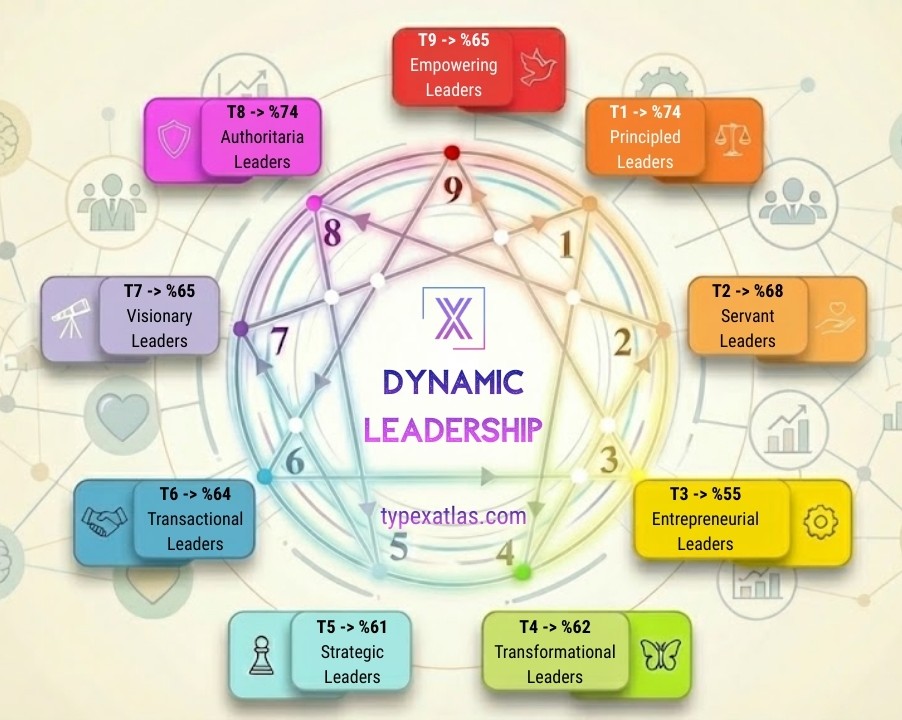
DLM research (Subaş, 2017) has identified significant inclinations between Enneagram types and leadership styles. The primary focus areas for each type in leadership are as follows:
- Type 1: Has a 74% inclination towards principled leadership. In leadership, principles, high standards, and improving quality are his primary focus areas.
- Type 2: Has a 68% inclination towards servant leadership. Relationship management, creating a climate of trust, and establishing a supportive structure are his primary focus areas.
- Type 3: Has a 55% inclination towards entrepreneurial leadership. Agile decision-making, results-oriented approach, and performance speed are his primary focus areas.
- Type 4: Has a 62% inclination towards transformational leadership. The search for meaning, creating an original vision, and cultural change are his primary focus areas.
- Type 5: Has a 61% inclination towards strategic leadership. Data analysis, long-term planning, and resource allocation are his primary focus areas.
- Type 6: Has a 64% inclination towards interactive leadership. Role clarity, defining outputs, and fair feedback mechanisms are his primary focus areas.
- Type 7: Has a 65% inclination towards visionary leadership. Expanding horizons, developing innovative language, and creativity are his primary focus areas.
- Type 8: Has a 74% inclination towards authoritative leadership. Taking responsibility in uncertain situations, making quick decisions, and using power are his primary focus areas.
- Type 9: Has a 65% inclination towards empowering leadership. Delegating authority, building consensus, and creating a harmonious work environment are his primary focus areas.
Factors that Make DLM Dynamic
The Enneagram is inherently dynamic, and DLM makes this flexibility measurable:
- Wing Effect: The nuances, emphasis, and tempo tones brought by neighboring types.
- Stress and Security Lines: Automatic behavior under pressure and expansive behaviors exhibited in a secure environment.
- Synthetic Personality and Differentiation Score: Analysis of the distance between the "learned mask" (role-based false self) rewarded by the context and the natural self.
- Ideal Self and Organizational Culture: The interaction between the image the leader wants to be and the organization's role architecture, norms, and rituals.
Our Solutions: Analysis, Development, and Transformation
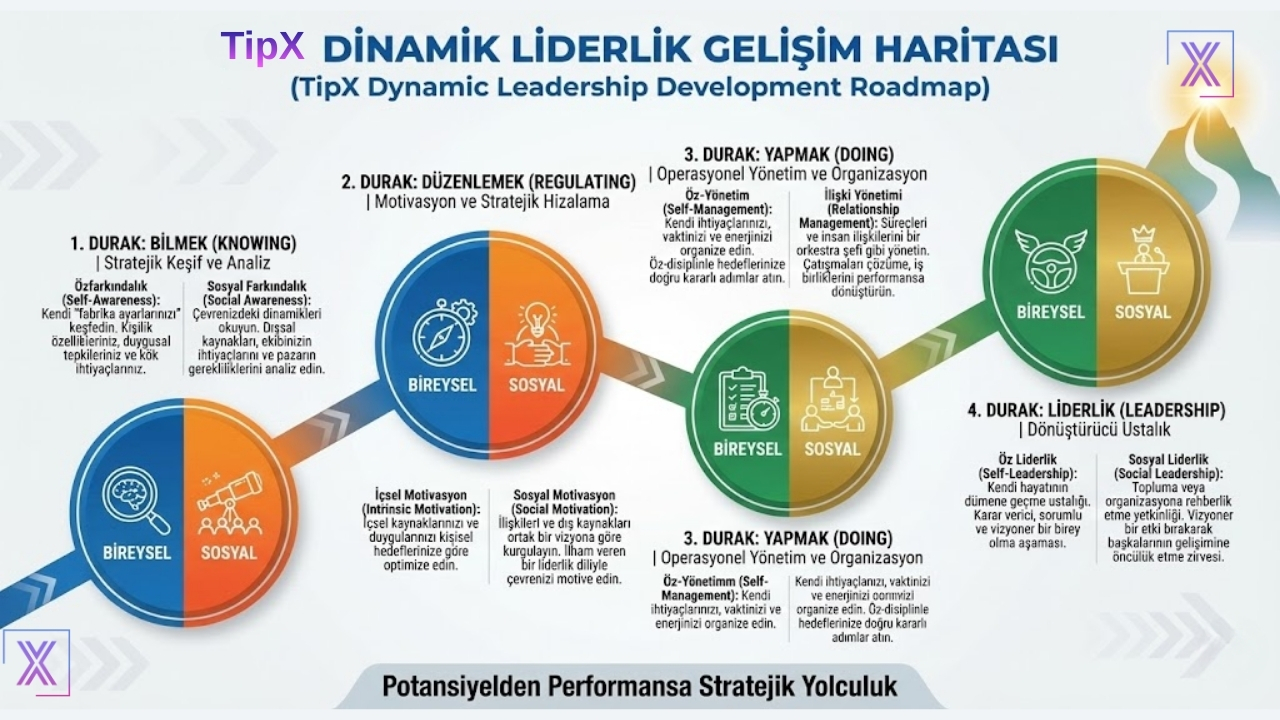
We base your leadership journey on concrete data and offer a three-stage solution architecture:
- Analysis: Using a dynamic leadership inventory and reporting system, we determine your Enneagram type and natural leadership style. We analyze your strengths and areas for development by identifying the style you currently emphasize the most.
- Development: Based on the analysis results, we design personalized training programs. With these programs, we help you strengthen your natural leadership potential while teaching you how to manage your stress/confidence behavior patterns.
- Transformation: With expert consulting support, we facilitate the integration of your leadership style into the work context and accelerate the transformation.
Digital Ecosystem (TipX Integration): DLM integrates with the TipX software ecosystem to bring together online inventories, interactive reports, comparative analyses, and 360° feedback processes, digitizing progress tracking.
Start Your Transformation Journey
Generate your own Dynamic Leadership Report to see your potential in a scientific mirror. Take the first step towards a flexible, effective, and charismatic leadership style now.