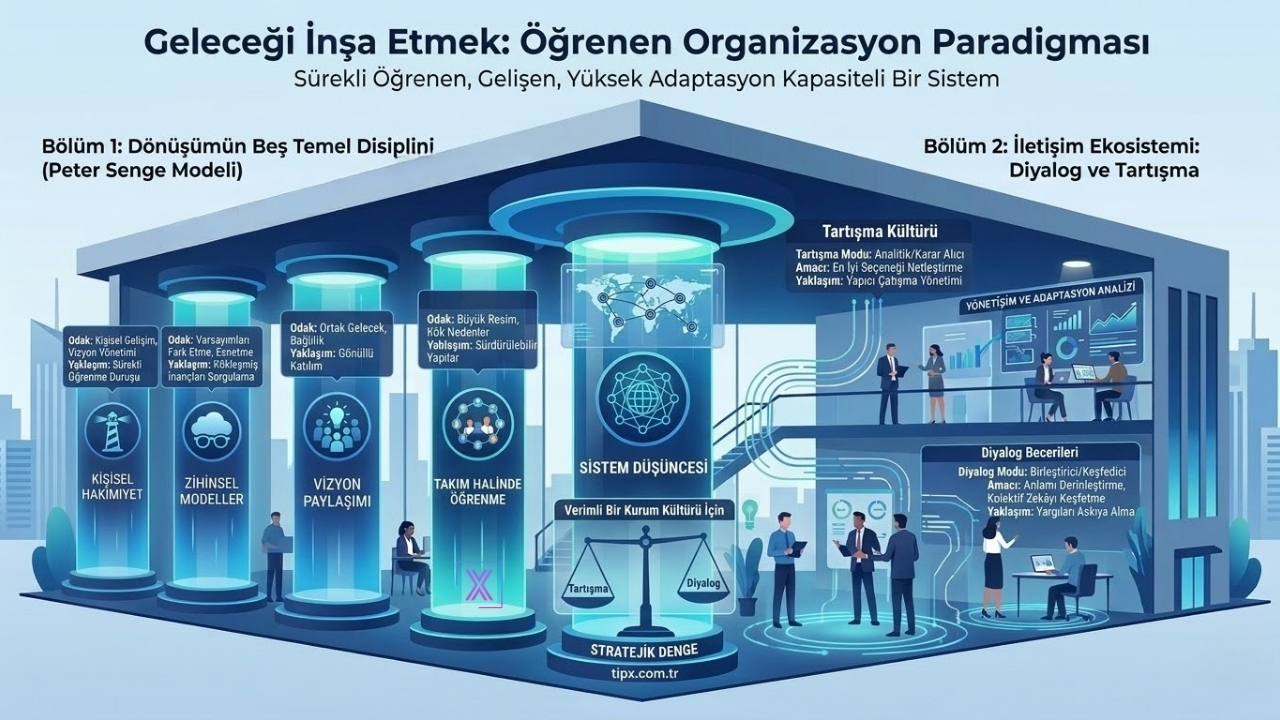
Section 1: The Five Disciplines of Transformation (Peter Senge Model)
This model, presented in Peter Senge's "The Fifth Discipline," aims to maximize the collective intelligence and adaptability of organizations.
1. Personal Mastery
- Focus: Personal Development and Vision Management
- Core Approach: It involves individuals clarifying their professional vision, focusing their energy, and adopting a "continuous learning" mindset. It represents a commitment to always being open to development and acting with rational awareness, rather than simply stating, "I have achieved it."
2. Mental Models
- Focus: Recognizing and Challenging Assumptions
- Core Approach: It involves breaking the "we've always done it this way" mindset, making ingrained beliefs and automatic processes visible and questioning them. It is the flexibility to re-evaluate events not as they "are," but with the question of "how do we see them."
3. Shared Vision
- Focus: Common Future and Commitment
- Core Approach: It involves creating a common vision of the future that everyone in the organization believes in, rather than dictating a vision from the top down. It ensures that teams are motivated not only out of obligation, but because they want to be a part of that future.
4. Team Learning
- Focus: Synergy and Collective Intelligence
- Core Approach: It involves shifting from an "I know best" approach to a "we solve it" culture. It is about creating a shared thinking space where the problem-solving capacity of the team is greater than the sum of its individual members. It manages conflicts not as a disruptive element, but as an analytical learning opportunity.
5. Systems Thinking
- Focus: The Big Picture and Root Causes
- Core Approach: It is the main framework that connects the other four disciplines. It involves seeing events not as separate pieces, but as part of a whole that influences each other. It enables the creation of data-driven and sustainable structures that address the problem at its source, rather than temporary "band-aid" solutions.
Section 2: Communication Ecosystem: Dialogue and Discussion
In a learning organization, communication is the most fundamental information flow network of the system. A robust organizational structure uses the following two basic communication modes in a balanced way, as needed, to implement learning in teams:
1. Discussion Culture
- Purpose: To clarify the best option and reach a decision.
- Basic Approach: This is the decision-making mode where ideas clash, analytical evidence speaks, and options are eliminated. It clarifies issues by managing constructive conflict, without avoiding different ideas, and transforms them into an action plan.
2. Dialogue Skills
- Purpose: To deepen understanding and explore collective intelligence.
- Basic Approach: This is the exploration mode where judgments and preconceived notions are suspended; it is about listening to understand others and to see the bigger picture, not to defend one's own idea. It creates a safe space for the exchange of ideas, unlocking the potential of the team.
Strategic Balance
A truly learning organization positions Dialogue (Exploration/Understanding) and Discussion (Analysis/Decision Making) in a complementary manner. Being only analytically discussion-focused can lead to quick decisions but may damage team cohesion; being only dialogue-focused can increase trust but may slow down operational decisions. The ideal is for both competencies to work effectively within the organizational culture.