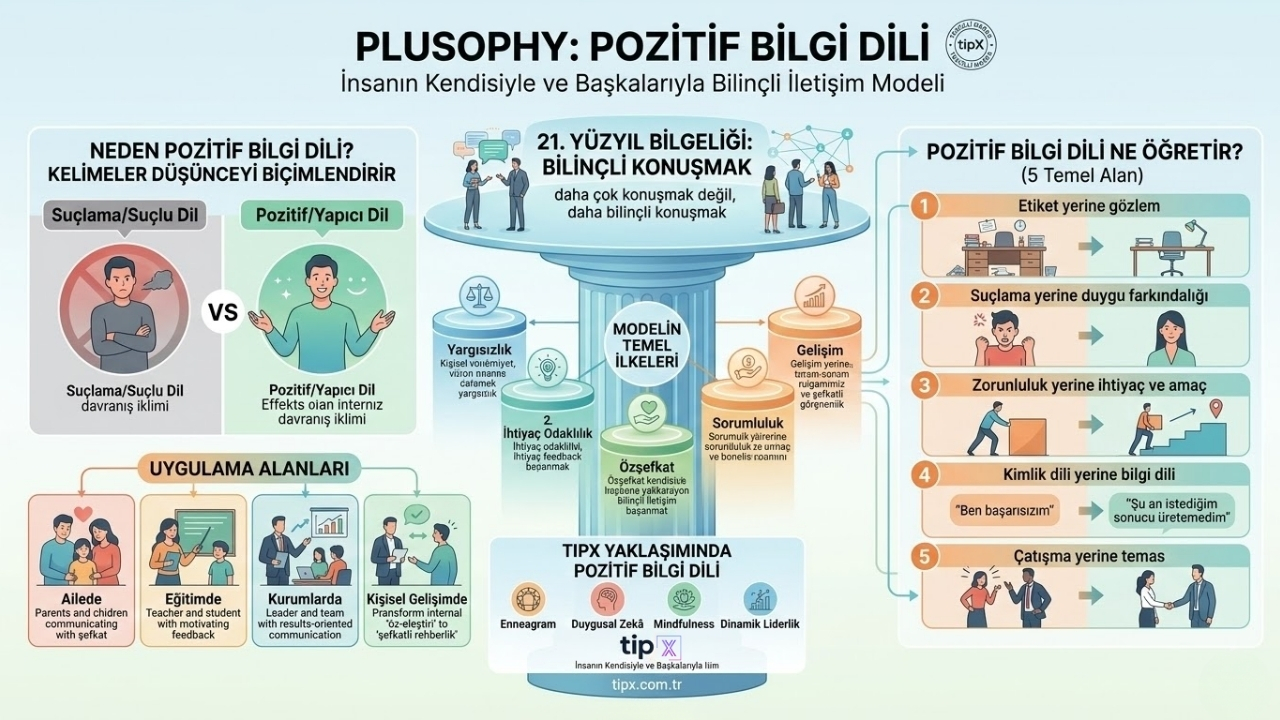
Positive Language Framework emphasizes encouraging, respectful, and constructive language instead of labeling and demoralizing language; it prioritizes need and goal-oriented expression instead of the "-malı/-meli" imperative.
"Plusopyh: Positive Language" is a registered trademark of the Turkish Patent Institute.
Positive Language
Positive Language is not just about "speaking nicely."
It is a conscious communication model that transforms a person's relationship with themselves, their child, their student, their spouse, their team, and society; it shifts language from being an instrument of judgment to an instrument of awareness, need, and development.
The fundamental question of this model is:
Does what we say narrow the person down, or does it open up a space for the person to understand and transform themselves?
Positive Language centers on observation instead of accusation, information instead of labeling, need instead of pressure, awareness instead of shame, and constructive feedback instead of destructive judgment. It acknowledges that language not only facilitates communication but also shapes self-perception, relationship trust, and the behavioral climate. This approach aligns with the "power of language to transform the world" that is emphasized in your writings: "Change your language, change your world."
21st Century Wisdom
Today, one of the greatest needs of people is not to talk more, but to communicate more consciously.
Because many conflicts arise not only from differences of opinion, but also from judgmental language, labeling, unmet needs, and the misrepresentation of emotions. Positive Language loosens the patterns that define a person as "you are this"; instead, it emphasizes questions such as "how are you feeling right now, what do you need, what do you want to improve?"
Thus, communication shifts from a power struggle to a space for noticing, understanding, and growing together.
Why Positive Language?
Because words not only convey thoughts; they shape thoughts.
People gradually begin to live in the climate of the language they use to address themselves and others.
A language that constantly accuses, shames, belittles, and is based on "you have to"; can increase feelings of defensiveness, withdrawal, resistance, and worthlessness in the individual. In contrast, a constructive, open, needs-based, and compassionate language fosters trust, self-awareness, and collaboration. The positive and conscious language used in the texts you uploaded supports the student's confidence, sense of belonging, and intrinsic motivation, and emphasizes that converting "should/must" language into needs-based language strengthens self-regulation.
What Does Positive Language Teach?
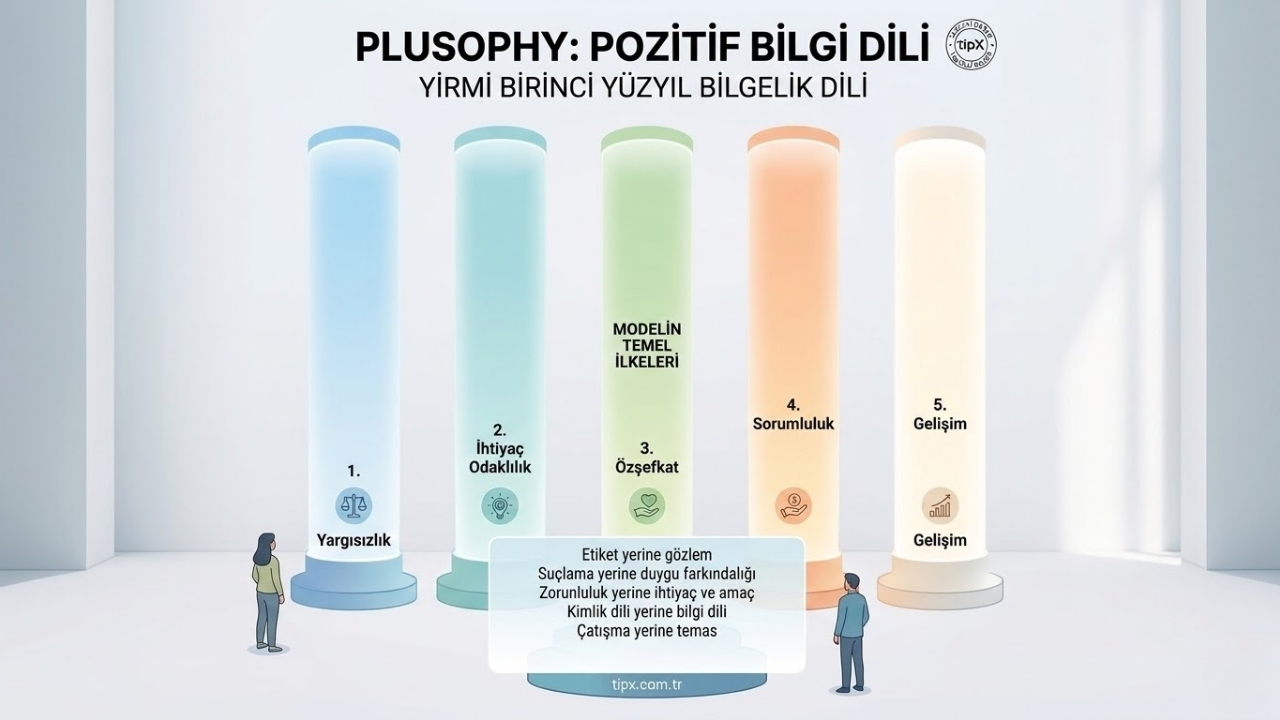
1. Observation instead of labeling
Instead of saying "You are messy,"
it teaches how to say "There are many items on the table right now."
2. Emotional awareness instead of accusation
Instead of saying "You are annoying me,"
it teaches how to say "I am feeling stressed and tense right now."
3. Needs and purpose language instead of obligation
Instead of saying "You have to do this,"
it teaches how to say "Doing this can support your goal." This approach is directly emphasized in the texts you uploaded.
4. Information language instead of identity language
Instead of saying "I am a failure,"
it teaches how to say "I was unable to produce the desired result at this time, I did not succeed."
5. Connection instead of conflict
Instead of trying to be right,
it teaches how to make feelings, needs, and common ground visible.
Basic Principles of the Model
Non-judgmental:
It talks about the situation, not the person.
Needs-focused:
It seeks the underlying need behind the behavior.
Self-compassion:
It also transforms the language the person uses towards themselves.
Responsibility:
It opens a space for open and honest expression, without blame.
Growth:
It uses language as a tool for growth and regulation, not as a tool of destruction.
Areas of Application
In the Family
It creates a communication climate that does not produce fear, shame, and pressure in the parent-child relationship; it identifies emotions, recognizes needs, and sets boundaries with compassion.
In Education
It transforms feedback into a structure that is instructive, motivating, and confidence-building, without damaging the student's self-perception. As clearly emphasized in the educational texts you uploaded, positive teacher language supports the student's confidence, self-esteem, and sense of participation.
In Organizations
The administrator language makes internal team feedback, conflict resolution, and leadership communication clearer, more respectful, and more effective.
In personal development
It transforms a person's inner dialogue, reducing the burden of self-criticism; it develops a more realistic, compassionate, and responsible inner language.
Positive Knowledge Language in the TipX Approach
In the TipX approach, a person is a whole, not just through their behavior, but also through their emotions, needs, attention, search for meaning, and way of relating. Therefore, language is not just about word choice; it is at the center of personality, emotional intelligence, awareness, and leadership development.
Positive Knowledge Language,
brings the Enneagram's area of self-awareness,
Emotional Intelligence's capacity for emotion regulation,
Mindfulness's non-judgmental awareness,
Dynamic Leadership's relationship management dimension
into daily communication practice. On the existing models page, the TipX models are presented on the axes of individual awareness, self-management, relationship management, and development; this new text is consistent with that framework.
Conclusion
Positive Knowledge Language is
a way of setting boundaries without diminishing a person,
giving feedback without hurting,
expressing emotions without suppressing,
supporting development without labeling.
Because sometimes the first thing that changes in a person's life is not their behavior,
but how they speak to themselves and others.
And often, when the language changes, the relationship changes.
When the relationship changes, the climate changes.
When the climate changes, people begin to change.